Really well done. I was amused by the sort of questions he got from the biology students, particularly the ones tinged of postmodern marxist antihumanism (specifically the one from the girl questioning why we should not just let evolution take its course and wipe us out).
Bennett, I actually think his position is very conservative.
We should go out there to every asteroid which is a threat and install transponders, then change the orbits of every asteroid we can so it will never hit Earth - even make them more convenient for mining.
Trent, I'm with you on that. Since this IS a concern of all the nations of the world, funding what you suggest could be accomplished with no pain to any one nation.
This work, and fuel depot duty, could keep companies like LM/Boeing/SpaceX in full/expanded production for years to come. Not to mention the various international launch providers that have the capability to participate in the task.
Over the last year the space advocate community has splintered into two major groups in answering the question "where should we go next?" Moon First or Mars First . This division was present in the Review of Human Spaceflight (aka Augustine) committee's final report in late 2009, with the surprising conclusion that there isn't the funds for either, suggesting a number of intermediate destinations first - including asteroids. However, as few people consider asteroids to be truly interesting destinations for the human utilization of space ( except me! ), the debate rages on. Many Moon First advocates are "Mars Next" advocates while most Mars First advocates are "Moon Again?" detractors. The former claim that Mars exploration will benefit from lunar exploration, particularly in experience and risk reduction, and perhaps the procurement of propellant. The latter claim that lunar exploration is just a distraction and want to avoid the risk of be...
The public is incredibly easy to fool. Way back in 2004, Mike Melvill made history by flying Burt Rutan's beautiful creation SpaceShipOne across the unofficial border to space, twice, and later that year Brian Binnie did it again, winning the Ansari X-Prize and raising the hopes of all that private access to space had finally arrived. But how did they do it? There is no question that Burt Rutan is a natural genius at aircraft design. His true innovation on SpaceShipOne was the shuttlecock styled effortless reentry system, and in particular, the ease of replacing these two large booms after a few flights to mitigate wear. SpaceShipOne/Two is a glider, and just like the Space Shuttle the wings are "only" used on the way down. There are wings used on the way up, of course, they are on WhiteKnightOne/Two, but once separated from the carrier aircraft the only lift is generated from the rocket. As smart as Burt Rutan is, he's not a rocket guy. For SpaceShipOne he...
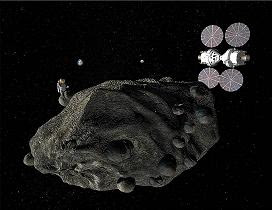
Anyone who has enjoyed my recreational attempts at designing a human mission to a near-Earth asteroid should check out the newly released mission to an asteroid by a team at Lockheed Martin*. The report ends with these important words: The Plymouth Rock study shows that the first visits to asteroids can be easier and earlier than we have previously thought. The United States does not need to wait for more advanced technologies or develop expensive dedicated deep space vehicles. We can explore the asteroids within a decade, using spacecraft already being developed and tested. This is a reasonable statement which I agree with. As far back as Apollo the question of "are we ready?" has been asked, and despite the success of Apollo it is still being asked. I have tried to make the argument that a Dragon capsule would be sufficient for a bare-bones mission to an asteroid, assuming some modifications to life support systems, dual use of propellant and supplies as radiation s...
Really well done. I was amused by the sort of questions he got from the biology students, particularly the ones tinged of postmodern marxist antihumanism (specifically the one from the girl questioning why we should not just let evolution take its course and wipe us out).
ReplyDeleteI encourage everyone to watch this. You're correct to bring this to greater attention, and lauding it in such a restrained manner (hard to do).
ReplyDeleteBeyond debate is the value of being introduced to the concept of increased risk to an area of the planet that an orbital adjustment brings with it.
A geopolitical issue, indeed!
That the incidence of needing "to duck" is guaranteed to grow in the next 10-100 years adds even more reason to enable BEO skill sets.
Bennett, I actually think his position is very conservative.
ReplyDeleteWe should go out there to every asteroid which is a threat and install transponders, then change the orbits of every asteroid we can so it will never hit Earth - even make them more convenient for mining.
Trent, I'm with you on that. Since this IS a concern of all the nations of the world, funding what you suggest could be accomplished with no pain to any one nation.
ReplyDeleteThis work, and fuel depot duty, could keep companies like LM/Boeing/SpaceX in full/expanded production for years to come. Not to mention the various international launch providers that have the capability to participate in the task.
This comment has been removed by a blog administrator.
ReplyDeletestansbrain, no politics, thanks.
ReplyDelete