Posts

Showing posts with the label commercial space

How Important Is Opening The Frontiers Of Space?

Image
I have previously written about why space settlement is important , but just how important is it? In a recent interview Rand Simberg comments: "What risk you're willing to take is a function of what it's worth to you. In World War II, we sent up squadrons of B-17s over Germany every day - sometimes half of them didn't come back. We tried to minimize the casualties, but we didn't stop flying just because we were having huge losses. What they were doing was important, and we were willing to risk lives to do it." He was not just referring to the current government efforts at human spaceflight, but also to the growing concern with safety by private spaceflight providers. Just how important is commercial spaceflight? At a recent hearing of the House Committee on Science, Space, and Technology , Rep E.B. Johnson (D-Texas) answers: "So far the only potential non-NASA market that NASA has identified for Congress are super-wealthy space tourists, and no...

A Little Ray Of Sunshine

Well it seems someone managed to sneak into the commercial crew office at NASA and smack them with a clue stick. Today they announced that there will be a third round of Space Act Agreements to maximize the $406M awarded for the program in FY2012. That's the way NASA sees it anyway. What this actually means is that the partners which are selected - and we're told they desire to select more than one - will be free to pursue their own goals without the burdensome oversight of the growing commercial crew office. It means that companies like SpaceX can design their Dragon capsule to service both NASA's needs and the needs of other companies like the recently announced Statolaunch without asking Mother May I? I can't wait to see the milestones.

The Case Against SpaceX

As an advocate of commercial spaceflight I can understand why many find it difficult to write objectively about SpaceX - which is arguably the poster child of this nascent industry. As a result, the majority of negative commentary about our darling comes from a horrible "journalist" like Andy Pasztor at The Wall Street Journal or a traditional aerospace mouth-piece like Loren Thompson at Forbes. An occasional coherent comment on a blog or space forum may be accepted by the space community as containing a nugget of truth, but these are easily filed in the don't-think-too-hard-about basket and forgotten. I've taken to thinking about the criticism I have heard, and after some long and rather arduous discussion with these critics I've processed it through what I hope are reasonable and constructive filtering. Here's the finished package. The Circuitous Route To Reuse Since SpaceX first announced the Falcon 9 they have claimed it is designed to be reusable, bu...

Why Commercial Crew Is Doomed

Image
NASA's Commercial Crew Development program, or "CCDev", has been a resounding success - and that's why they're not doing it anymore. Inspired by the earlier Commercial Orbital Transportation Services program, or "COTS", and funded by the American Recovery and Reinvestment Act of 2009 stimulus to the tune of $50M, CCDev came out swinging in 2010 with five US companies producing impressive results on what was essentially bonus pay to NASA. As such, it was no surprise when a further $270M was provided for the second round, or "CCDev2". This round is now coming to a close, with continuing achievement from US companies with minimal oversight from NASA. Also, a number of "unfunded" CCDev agreements have been made which receive only use of NASA facilities and expertise - they too have been successful. With all this success, it might seem strange that NASA is dropping the CCDev program - but they are. They intend to move on to a "p...

EML1 Buildup

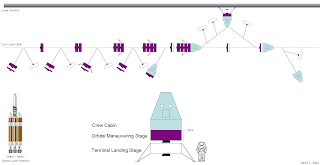
Today's space launch market is used to place satellites - commercial, scientific and military - into orbit, with the majority going to the geostationary orbit. In all such cases, the launch vehicle does not perform the final maneuver to circularize the orbit. The satellite is dropped off and circularizes its own orbit using on-board propellant. This is a significant delta-v change of about 1.6 km/s, and the remaining fuel is used to maintain the orbit, usually for 25 years or more. Launch to Geostationary Transfer Orbit, circularize using on-board propellant. This is the standard model for how satellites are deployed into space. It is a mature process which has served us well for decades. However, when planning an exploration architecture, it has always been treated as irrelevant. Here is a list of some current (and one near future) launch vehicles, their listed throw mass to GTO and the calculated mass that can be placed into the first Earth-Moon Lagrange point using a 3...

How COTS-D Was Killed

Lest we forget, under Mike Griffin NASA awarded to SpaceX an option in their Commercial Orbital Transportation Services contract to develop a crew transport capability. The Space Act Agreement looked like this: Milestone Payment Project Management Plan Review and Crew Demo 1 System Requirements Review $27,420,000 Financing D1 $10,000,000 Crew Demo 1 System Preliminary Design Review $22,420,000 Crew Demo 2 System Requirements Review $25,420,000 Crew Demo 1 Critical Design Review $20,420,000 Crew Demo 2 System Preliminary Design Review $20,420,000 Crew Demo 1 Demonstration Readiness Review $20,420,000 Crew Demo 3 System Requirements Review $25,420,000 Financing 2D $10,000,000 Crew Demo 2 Critical Design Review $18,420,000 Crew Demo 3 System Preliminary Design Review $20,420,000 Crew Demo 1 Mission $15,420,000 Crew Demo 2 Demonstration Readiness Review $18,420,000 Crew Demo 3 Critical Design Review $18,420,000 Crew Demo 2 Mission $8,420,000 Crew Demo 3 Demonstration ...

The Easy Way To The Moon

Image
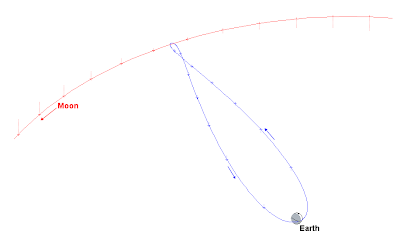
I recently described how to fly to the Moon solo using SpaceX hardware. Someone asked me why I worked out an Apollo 8 style flight and didn't just do a simple free return trajectory.. after all, it's a lot easier - and that's actually the reason - it's too dog gone easy. In order to make this interesting I decided to try to think of the easiest way to do a free return trajectory. Preferably, we'd like to use an unmodified spacecraft and launch vehicle and not have to develop any other hardware. For a start, let's forget this whole idea of an Earth Departure Stage - we'll just throw the Dragon spacecraft to lunar orbit. This sure is simple, but it only gives us 2585 kg to work with. This prompts the question, exactly what is the mass of an unladen Dragon.. yeah, yeah, I know - African or European? Looking at the Falcon 9 Users Guide we find that it can throw 9358 kg to 51.6º with an altitude of 400 km. SpaceX will happily tell you that the Drag...

My 2010 Review

I started this year thinking the Augustine committee had nailed the Moon shut. Considering that I was a proponent of Constellation before the Augustine committee, that's pretty significant. If I go back to that time and see what I was saying to people, most of it was explaining the flexible path as an alternative to sitting on the ground waiting for a booster and a capsule and a lander to be developed by NASA. I end this year thinking that the Moon isn't nailed shut. SpaceX has demonstrated that making a capsule and booster need not be expensive. Armadillo Aerospace and the other contractor's work on Project M (now Project Morpheus) demonstrated to me that going to the Moon need not be expensive. Tim Pickens and the Rocket City Space Pioneers have successfully restored my faith that the Google Lunar X-Prize will be won. Paul Spudis has actually become a robotic exploration advocate! In a few years time it won't be absurd to suggest that a commercial effort could ...

Soonest Space Solar Power

Image
Space Solar Power has a bad rap, caused predominately by advocates who can't separate the exciting long term vision from the short term facts. In his recent paper , Al Globus has tried to rectify this by investigating what can be done with demonstrated launch vehicles, solar collectors and power beaming (and without on-orbit assembly, manned outposts, lunar materials, etc). His conclusion is that it appears space solar power is now ready for niche markets, such as forward military bases, where the price of power can be as much as $1/kWh. The low cost launch vehicle of choice is, of course, SpaceX's Falcon 9. High specific power solar collection is achieved using thin-film heliogyros as demonstrated by the Japanese Ikaros satellite. The power beaming technology is infrared laser with custom solar panel receivers, as demonstrated by LaserMotive in their win at the Space Elevator Games last year. A minor improvement in Globus' architecture is apparent. The mass of ...

Apollo 8 Solo

Image
In 1927 Charles Lindbergh flew non-stop from Long Island to Paris. He was catapulted to instant fame by doing so and won the Orteig Prize . He didn't have a co-pilot. He didn't have an army of engineers monitoring his plane or a flight surgeon monitoring his heart rate, it was just him and his trusty single-engine monoplane, the Spirit of St. Louis . His achievement is heralded today as kick-starting the commercial aviation industry and opening up the skies to the everyman. But what of space? Could a modern Lindbergh fly an impossible journey and change the way we look at spaceflight forever? I think it can be done, and for cheaper than you might imagine. In 1968 the first humans left the vicinity of Earth, flew 6 days and nearly a million miles to the Moon and back. Their mission not only was the first, it also proved the feasibility of the missions to follow. Apollo 8 would have been much easier to achieve had they only wanted to swing-by the Moon, and still a sig...

The Space Industry

Here's a great video by Bob Stover, Tim Walters and Todd Halvorson.. one of the best I've seen.

Thoughts on a SpaceX Lunar Architecture

Image
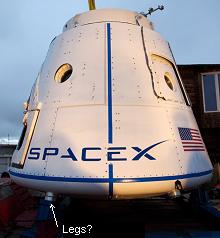
It's no secret that the SpaceX Dragon capsule has a very impressive heat shield believed to be capable of direct lunar return. Official statements from SpaceX that they intend to add deployable landing gear and leverage the thrusters in order to land on land in the future prompts an obvious suggestion: if it can land on Earth, could it land on the Moon too? The Dragon capsule has thus far been launched on the Falcon 9 booster, and although that booster is able to put 2473kg into lunar transfer orbit, after using the Draco thusters on the Dragon to enter low lunar orbit the total mass would be under 1876kg.. this seems a bit light for a crewed configuration, especially when you consider that only 1422kg of it could be returned to Earth. And that's just lunar orbit. We need a bigger rocket, and the official SpaceX plan right now is called the Falcon 9 Heavy. One should not be confused by the name, the F9H is not "heavy lift" in the sense often used by space ad...

Affordable Deep Space Exploration

Image
For too long the aspirations of NASA have not matched the budget allocated. Building the International Space Station has been a decade long effort, now finally reaching completion, and until just recently the plan was to splash it into the ocean before moving on to "the next thing". For a while, that was a return of humans to the Moon, but the recognition that the necessary budget would not be forthcoming has pushed that goal so far into the future that it doesn't even make much sense to talk about it anymore. Today, the focus is on making a new heavy lift vehicle, finishing a big heavy capsule to go on it, and considering the possible missions that could be done with that hardware should it ever be finished. At the same time, technology development and commercialization of ISS resupply promise to free up some existing budget dollars to pay for the lunar landers and prepare for the next next thing : Mars. This has prompted many to ask: what if we didn't need h...

Mining The Moon: Closing The Business Case

Image
I recently read Platinum Moon by Bill White, in just 4 days, it's just that much of a page-turner. Clark Lindsey has written an extensive review , which is mostly positive but has this little dig at the end: A kilogram of pure platinum today sells for something like $53,000/kg. On the Moon even rich PGM ore would have have to be extensively refined to get anywhere close to that purity. A kilogram of raw ore would be worth a tiny fraction of that. Until there are fully reusable vehicles flying frequently enough to LEO to bring costs there down to the low hundreds of dollars per kg, it's difficult to see how space mining can even begin to be viable. My first reaction is to suggest that obviously high purity enrichment of platinum should be done on the Moon, and only "pure platinum" returned to the Earth - but I should first point out that Platinum Moon made the realistic argument that lunar platinum would be worth a lot more than market value in the form of com...

Engineering An Asteroid Close Approach

Image
I've been posting lately about the threat large asteroids pose to Earth, human missions to smaller asteroids, and the opportunities that will exist in the next few decades to do so. Up until this point, my analysis has been mostly for my own education and amusement, but I'd like to make a suggestion now which I haven't seen published in the literature or seriously discussed in either NASA working groups or even in the space advocacy community. I'd like to suggest that we need not wait for an appropriate asteroid to come within range of Earth and plan human missions around just those opportunities - we can engineer a perfect close approach. Next year, at the start of June, the asteroid 2009 BD will pass within the orbit of the Moon . Even though it is not a rare occurrence, few opportunities such as this have been identified, and realistically, no-one is going to be ready to send a human mission to an asteroid for years to come. It seems a shame to let this clos...

Mission To Asteroid Using SpaceX Hardware - NASA's Target

Image
As a target of study, NASA has identified the asteroid 1999AO10 as the 2025 destination for human exploration. We've heard that NASA plans to build a giant heavy lift vehicle to make the trip, but is it really necessary? I previously described a human asteroid mission, but I assumed the logical choice of asteroid with the lowest known delta-v (and included analysis for the second lowest too), but for some reason this isn't as interesting to NASA, so let's consider how one might do the trip to their preferred target, using existing SpaceX hardware. The reference numbers are: Earth departure stage 3291m/s, and storable propellant 3939m/s of total delta-v. We could improve this by carefully measuring the boiloff of LOX in Falcon 9 upper stages and analyzing the required insulation to do the arrival rendezvous using non-storable propellants, but I don't really have that information handy, so I'll just go with the storables. Like last time, we'll use the ...

Flight To An Asteroid With SpaceX Hardware

Image
John Hare has an article about commercial beyond Earth orbit exploration in a world where cheap access to space has lowered the cost of a kg to LEO to $1000 or less. But I think it begs the question, how much does it cost now? Warning: contains Machiavellian humor. The biggest problem with commercial human beyond LEO flight right now is the lack of an affordable LH2 upper stage. In SpaceX terms: they don't have Raptor yet. But hey, no-one ever said you have to use LH2/LOX stages to go beyond LEO. If you're aiming at an asteroid at an optimal time, there's at least one target you can hit with only 2.8km/s of delta-v from LEO, and 1km/s of delta-v to rendezvous with the asteroid, 2006 RH120. (Note that you can divide this up any way that makes sense to you, but more than 1km/s of delta-v at rendezvous is probably undesirable. For a flyby of 2006 RH120 you need 3.733km/s). See this list . Personally, I'd rather aim at 2009 BD as it is almost always "clo...