
Posts

The Asteroid Menace

Image
Day one of the Exploration of Near Earth Objects Objectives Workshop saw the presentation of three key reasons to send humans to visit asteroids: science, mining and planetary protection. Of these, the last has has been shown to be an issue that attracts mainstream support, no doubt we have Bruce Willis to thank for this. The workshop began with presentations of the robotic missions that have been flown to asteroids and comets. The recently returned sample return mission Hayabusa , taking pride of place. All the presenters had war stories of the operational difficulty of flying to these objects, and some expressed surprise that their missions succeeded at all. They also talked about the high cost of these missions in terms of remote sensing equipment and the lack of good ground truth information to calibrate these instruments. Unsurprisingly then, they all support a human mission to an asteroid or a comet near Earth to more efficiently gain scientific results. However, when ...

Deep Fried Astronauts

Back in 1967 the Bellcomm put together a study for the then Manned now Marshall Spaceflight Center. The mission was a one year human flyby of Venus . The study included some innovative stuff, like using the Earth departure stage tanks as a living module after venting any remaining fuel into space, but it also contains a fair bit of misinformation about radiation exposure, advocating that no attempt be made to shield against galactic cosmic radiation. This is to be expected. What isn't expected is that this is still the general consensus today, even though a more recent computational study has provided some interesting numbers for various shielding materials. Shield Material (5g/cm^2) Annual radiation dose (mSv*) Aluminum 542 Polyethylene 450 Iron 581 * Quality factor recommended in ICRP-60 is assumed. This looks pretty good when the astronaut lifetime radiation limits are considered. Astronaut age Career effective dose limits (mSv, average life loss) Males Female...

Throwing Stuff In Space

In my last post about the Russian space program I said that cosmonauts regularly throw stuff in space so it will burn up and not result in permanent space junk. A reader asks whether you can actually do this.. Man, way to ask a hard question. Orbital mechanics says "if a space vehicle comes within 120 to 160 km of the Earth's surface, atmospheric drag will bring it down in a few days, with final disintegration occurring at an altitude of about 80 km", and we can work out how much delta-v a cosmonaut has to impart to get the semi-major axis of the orbit of the debris below 160 km. dVA = sqrt(GM*(2.0/rA - 1.0/((rA + rB) / 2.0))) - sqrt(GM/rA) where rB = 160km + roE where rA = 278km + roE to 460km + roE where roE = 6378.1km where GM = 6.67300 * 5.9742 * 10^24 * 10^-11 with the ISS at 278km the delta-v retrograde is 34.684365m/s or 77.5867148 mph, which is major league baseball. with the ISS at 428km the delta-v retrograde is 77.243278m/s or 172.788292 mph, with is sp...

A Disappointing End To The Russian Space Station Program

Image
Thankfully no-one really cares about the Russian space program, or, ya know, they don't speak English, I guess. Everyone has heard of Mir but name any prior station. Go on, name one. Ok, that's easy, but how many space stations did the Russians have before Mir? I'll get back to you on that. So what was the point of all these stations? We all know the reason why the US has the ISS, and anyone who watched the Augustine committee proceedings last year heard about why the "international community" is demanding it be extended until 2020 and beyond. Scientific research or something right? The 2005 NASA Authorization Act designated the ISS as a national laboratory. Oh sorry, the American segment of the ISS, because obviously the US can't designate the Russian segment as a national laboratory of the US, but that's what it is right? Well, no. The Russians do very little scientific research on the ISS. They have only "mini-racks" on the Pois...

Nuclear Rockets In The Atmosphere?

Image
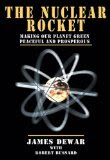
In James Dewar's latest book he proposes the development of a new solid core highly enriched uranium rocket engine based on the B-4 core developed in the Rover/NERVA program, but unlike that program he recommends starting small, testing in a dedicated exhaust processing facility and building successive generations of engine to prove safety and gain operational experience. The first engine to be put into operation would have 40,000lbf (800MW), an ISP of 1,000s and weigh 6,000lb. It would have a maximum burn time of 15 minutes. The gross mass for the stage would be 91,000lb with 45,000lb of LH2 fuel, and a 3,000lb cocoon to recover the engine, to deliver a 17,000lb payload to LEO*. The stage would be dropped from 50,000ft by a cargo plane (such as the C-5A), and solid rocket boosters would carry it to 100,000ft before the solid core engine engages. The deorbited engine in its cocoon would be recovered from a splashdown for processing, as the U-235 would only be ~1% spent in the...

Scaled Composites' Dirty Little Secret

The public is incredibly easy to fool. Way back in 2004, Mike Melvill made history by flying Burt Rutan's beautiful creation SpaceShipOne across the unofficial border to space, twice, and later that year Brian Binnie did it again, winning the Ansari X-Prize and raising the hopes of all that private access to space had finally arrived. But how did they do it? There is no question that Burt Rutan is a natural genius at aircraft design. His true innovation on SpaceShipOne was the shuttlecock styled effortless reentry system, and in particular, the ease of replacing these two large booms after a few flights to mitigate wear. SpaceShipOne/Two is a glider, and just like the Space Shuttle the wings are "only" used on the way down. There are wings used on the way up, of course, they are on WhiteKnightOne/Two, but once separated from the carrier aircraft the only lift is generated from the rocket. As smart as Burt Rutan is, he's not a rocket guy. For SpaceShipOne he...

Coding Orbital Mechanics

I forget what inspired me, probably discussions about propellant depots, but after an hour of two playing around in the great spaceflight simulator Orbiter I decided to give the old orbital mechanics another go. I've written dynamic physics simulators before which have really nice accuracy and can handle the big numbers required for orbital simulations, including three body problems, but I never managed to tackle the classical orbital mechanics - too much Greek terminology I guess - until today. I set myself a somewhat difficult task: Given a position vector r and a velocity vector v , somewhere above a reference (say, a planetary body) calculate all the required classical orbital elements: a - semi-major axis e - eccentricity i - inclination l - longitude of the ascending node w - argument of periapsis t - true anomaly There's others, but they can be derived from these. You'll also note I haven't used any Greek letters that my keyboard doesn...

Dr Paul Spudis Responds - Sorta

I thank Dr Paul Spudis for responding. His post isn't addressed to me but it certainly appears to be directed at me. Clearly if we don’t go to the Moon with people or machines, there is no way to use the abundant water, metals, and other lunar surface materials to create new capabilities in space. Supporters of the new path suggest instead that we can obtain all the materials we want from near-Earth asteroids .. in my dreams! Us asteroid mining advocates are a minority who have been swept aside in this debate. Asteroids are a "stepping stone" to Mars, not a destination. As Clark puts it: As pointed out many times here, the main impetus for the Flexible Path option was simply to have useful and interesting in-space missions underway while landing and surface systems for Moon and/or Mars were in development. Spudis also makes good points about the difficulty of extracting resources from asteroids. This is often cited as justification for human missions. What ...

Book Of The Week: Kim Stanley Robinson's Mars Trilogy

Image
The Book Of The Week this week is Kim Stanley Robinson's "Red Mars", "Green Mars", "Blue Mars". This is often referred to as the Mars Trilogy, but none of these books are about Mars. There's plenty of awesome scientifically accurate detail in these books on Mars geology, the moons of Mars, Mars colonization, Mars terraforming, and even some interesting speculation about Mars native life and building a space elevator on Mars. The books are certainly set on Mars but that's as far as it goes. In my opinion, these books are as much about Mars as Hamlet is about Denmark. These books are about politics, the real kind, and what happens when it devolves into war. The books start with group dynamics, petty infighting, the formation of camps and the inevitable fracturing of community. The lines are: those who want to terraform Mars and those who want to keep Mars red. But the battle lines don't really matter, what was shocking was how qui...

Misrepresenting The Gap

Ever get that feeling you're shouting into the void? Rand Simberg, someone who's opinion on space I truly value, has written an article on The Gap, and taken the well trod path of how bad it is to be reliant on the damn Ruskies . With the coming retirement of the Space Shuttle, the most immediate issue in human spaceflight is how to get U.S. crews to the International Space Station. When the decision was made in 2004 to retire the shuttle, the plan was to have a small "gap" starting this year, during which the Russians would provide this service, as they did for the two-and-a-half-year period after Columbia was lost. But if lawmakers in the House have their way, we could be buying rides from Russia to the space station for the foreseeable future. Argh. Rand, you know better, so I'm just going to have to assume you're playing down to the saps who read AOL News (and I imagine they are saps, cause who reads that?). As you know, the Soyuz has been used...

Hating On Propellant Depots

Dan Adamo is a retired flight dynamics officer for the Shuttle program and does space mission trajectory, design and operations in his sleep. I recently saw him put together a design reference mission for a human mission to the moons of Mars, for fun , using only well understood technology. Back in February he did a Space Show Classroom where he discussed many topics and once again demonstrated his effortless grasp of orbital dynamics. A listener asked about propellant depots and Adamo answered with what I think is the most articulate objection to the concept of low earth orbit propellant depots. He went on to talk more favorably about propellant depots at Lagrangian points and on the surface of destinations such as the Moon and Mars, but I think his objections are more interesting. Starting from the ground up, here's where I have problems with propellant depots, in low Earth orbit. Once you establish the depot, it can be empty for all I care at this point, but once you...

My Reason For Human Lunar Return

Why go back to the Moon? I've asked that question a lot , and I've gotten a variety of answers. There's a lot of nice resources on the Moon and the energy requirements to lift them from the Moon is a lot less than required to lift them from the Earth. There's water, which can be used for propellant, and there's metals, both in the lunar regolith and in more significant deposits from asteroid impacts.. but I disagree that we need humans to retrieve those resources. The Apollo program only scratched the surface (literally) on lunar science. There's a whole lot of mysteries that lunar geologists don't have good answers for: nonmare domes, rilles, potentially active volcanic vents, the entire far side, and permanently shadowed craters.. but I again disagree that we need humans to do that science, and if NASA was at all serious about it they would have sent at least one rover to the Moon ever . I have advocated the viewpoint that what should motivate...

"Access To Space"

Andre Bormanis has an article over at The Space Review which includes this nugget: The US frequently partners with other countries and international organizations on space missions, primarily in the field of robotic exploration. Partnering in the development of manned systems has been resisted because of a belief, held deeply by many in government and among the public, that the US needs to have independent human access to space to maintain its status as a world power. If the Russians and Chinese can send people into orbit, so the reasoning goes, the US must as well, or risk being perceived as a declining power on the world stage. Oh, is that what "access to space" means? Well, as someone who is outside the US, I feel I can safely say: no-one cares . Yes, "soft power" exists, but no-one knows the names of astronauts anymore - they're just government employees who go up to an incomprehensible space station to pretend they're doing Important Work that ...

CCDev Is Dead

Image
Ok, I don't usually write these sorts of things, but I think this is so incredibly terrible news that I feel the need to vent. The NASA Authorization Act of 2010 kills the commercial crew development program, while simultaneously killing any chance of funding SpaceX's COTS-D option. It contains these lies: Sec. 241. Affirmation of Policy Reaffirms the policy of making use of United States commercially provided International Space Station crew transport and crew rescue services; limiting the use of the government system to non-ISS missions once commercial crew transport and crew rescue services meeting safety requirements become operational; and facilitating the transfer of NASA-developed technologies to United States commercial orbital human space transportation companies. All politicians lie, it's what they do, but it would be good if they could at least be consistent in the same document.  What follows in Sec 242 is a long list of restrictions to make it completel...

What Is The Gap?

I don't even know anymore. Buzz Aldrin has written another article , this time over at the Huffington Post. A number of my former colleagues, and other critics, have expressed concerns about the plan, and in particular, they express grave reservations about 'the Gap' -- the end of the Space Shuttle Program, and the inability for the US to provide human access to space -- save for limited flight opportunities and capabilities with our Russian partners, pending the maturing of the commercial space transportation capabilities, or other future systems to meet these needs. So it's about "human access to space". Ok, to do what? Why do you want human access to space? What's the point of it? Unless you address that question you can't seriously talk about what kind of access to space you need. Will suborbital access do? No? Ok, how about one orbit? No? Ok, how about 2 days? No? How about 2 weeks, the endurance of the shuttle? No? Oh, permane...

A Likely Scenario

I was recently asked, "if a killer asteroid was approaching Earth, how much would they actually tell us?" This is my response. They'd tell you numbers which you wouldn't understand. Then the pundits would turn those numbers into something they can scare you with, probably overblowing the threat while they do so, and Concerned Citizens would go to their Congressmen demanding answers. NASA would provide those answers.. in a completely unintelligible way, and someone would interpret those answers as dismissing the threat. Then there'd be a big argument over whether it's a threat or isn't it. Eventually one of the egg heads with a wife will get a lecture about talking like a normal person once in a while and a press statement would be released saying exactly how likely and excessive the threat is (after it went through a few committees to ensure it was easy enough to understand, and defend). By this time the media will be completely bored with the story ...

How Near Are The Near-Earth Asteroids?

Image
Back in 1978, following three successful free flights of Space Shuttle Enterprise the year before and the first lift-off of Space Shuttle Columbia only 3 years away, planetary scientist Gene Shoemaker and astronomer Eleanor Helin collaborated on a paper which presented the then shocking conclusion that some near-earth asteroids required less delta-v to reach than Mars. The near-term availability of the Space Shuttle was key, as the high flight-rate it promised meant a manned mission to an asteroid could be staged in low Earth orbit for as little as 23 flights. At the time, it wasn't unreasonable to suggest that within a few years that would be as little as 6 months of staging, and the vehicle would be reusable! Of course, the Shuttle's flight rate never got that high, and today's mission designs to Mars are measured in International Space Station masses to remind us of how long it takes to amass payload in orbit. This paper, however, remains important for the math i...

Book Of The Week: Peter F. Hamilton's "Fallen Dragon"

Image
The Book Of The Week this week is Peter F. Hamilton's "Fallen Dragon". Although there's some similarities to military tales like Starship Troopers, the book is primarily a commentary on the ever encroaching power of multi-national corporations on our society and the individualist to community to national government struggles to live with it, along with some transhumanist alternatives. Corporations in the future described by the book have taken over space colonization and found a somewhat inelegant solution to the problem of how to turn a profit: armed robbery. Of course, legally they're on sturdy ground - euphemistically referring to the practice as "asset realization" - but it's nothing more than tax extraction through force and so serves as a neat covert commentary on the origins of government power. Hamilton's gift is his efficiency of description, and with space technology he manages to simultaneously summarize the great concepts for t...

The Future Mines Of Humanity

Image
Dr Phil Harris is a Moon First space advocate and a published and acclaimed author. In his book Space Enterprise: Living and Working Offworld in the 21st Century , he goes into exquisite detail of the challenges and the bounties of industrializing the lunar surface. In early January of this year Harris authored a special White House strategy paper [redistributed with permission] which recommended a pushing forward on the Vision For Space Exploration, or at least the Moon focused vision that came out of it. He makes it very clear that the reason to go back to the Moon is to get resources and reduce the national debt. Now is the time to enlighten our nation's citizens of the vast resources to be tapped on the Moon. We could not only mine the lunar surface for valuable minerals and gems, but we could use its water and regolith to support lunar industrialization and settlement! Those last two words are the only mention of settlement in the entire paper - so this is an economi...

Desperately Seeking: Moon First Advocate

Image
As it seems Paul Spudis isn't going to respond I am left without a sparring partner. Anyone who wants to pick up the gloves and make the case for returning to the Moon, come at it. The ground rules are simple: you must make an argument as to why we should return to the Moon first . It would also be good if you could explain how NASA can do it within a time frame that can be sold politically and within the current budget profile, but I'll settle for a why that makes sense. Note that if you just preach the dogma of someone else, you're unlikely to be able to defend it, so, please, only apply if you've got the stones.