Posts

How COTS-D Was Killed

Lest we forget, under Mike Griffin NASA awarded to SpaceX an option in their Commercial Orbital Transportation Services contract to develop a crew transport capability. The Space Act Agreement looked like this: Milestone Payment Project Management Plan Review and Crew Demo 1 System Requirements Review $27,420,000 Financing D1 $10,000,000 Crew Demo 1 System Preliminary Design Review $22,420,000 Crew Demo 2 System Requirements Review $25,420,000 Crew Demo 1 Critical Design Review $20,420,000 Crew Demo 2 System Preliminary Design Review $20,420,000 Crew Demo 1 Demonstration Readiness Review $20,420,000 Crew Demo 3 System Requirements Review $25,420,000 Financing 2D $10,000,000 Crew Demo 2 Critical Design Review $18,420,000 Crew Demo 3 System Preliminary Design Review $20,420,000 Crew Demo 1 Mission $15,420,000 Crew Demo 2 Demonstration Readiness Review $18,420,000 Crew Demo 3 Critical Design Review $18,420,000 Crew Demo 2 Mission $8,420,000 Crew Demo 3 Demonstration ...

New Space Music Video

Image
An idea that has been bouncing around in my head for a few years.. Great to finally get it out.

Making Fusion Rockets Relevant

Image
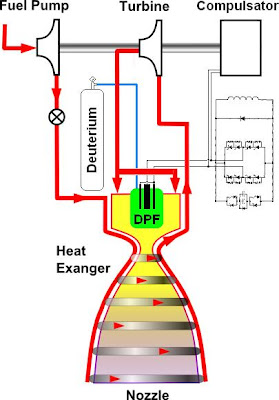
If you read the literature on fusion rockets you probably have a pretty firm idea in mind of what they're good for and when they'll be relevant - in "the future". No good fusion rocket paper is complete without a superconducting magnet here, and a magnetic nozzle there - in fact, these widgets are a primary ingredient of any fusion propulsion design and the more infeasible or untested they are, the better. This seems obvious: fusion rockets are the future because we don't have fusion yet.. right? Actually, no. Producing nuclear fusion isn't all that hard. Amateurs regularly cobble together desktop fusion devices like the Farnsworth Fusor and other contraptions. The significant hard problem of fusion is getting more energy out of the device than you put into it. The current government backed effort to achieve this is the ITER project who are building a tokamak style device, but many other schemes are also being tried, with significantly less fundin...

Space Colonization As The Savior Of Progress

The idea of Progress, as defined by J. B. Bury , proclaims that "civilization has moved, is moving, and will move in a desirable direction". Ever since the 1960s the belief in Progress has been waning and some would say that it has been completely lost to the current generation. Going beyond Bury's definition, Taylor E. Dark III provides three mutually reinforcing and interlocking premises : 1. NO LIMITS. There are no fundamental limits – nor should there be – on the collective human capacity to grow, no matter how growth is defined (which may be in terms of knowledge, wealth, power, population, or morality). Progress is endless (or at least indefinite for all practical purposes). 2. ALL GOOD THINGS GO TOGETHER. Advancements in science and technology, and the resulting mastery over nature, expand our knowledge, wealth, and power, and, in so doing, bring improvements in the moral, political, and spiritual character of the human race. The elements of progress ar...

The Easy Way To The Moon

Image
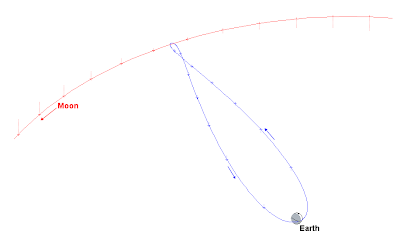
I recently described how to fly to the Moon solo using SpaceX hardware. Someone asked me why I worked out an Apollo 8 style flight and didn't just do a simple free return trajectory.. after all, it's a lot easier - and that's actually the reason - it's too dog gone easy. In order to make this interesting I decided to try to think of the easiest way to do a free return trajectory. Preferably, we'd like to use an unmodified spacecraft and launch vehicle and not have to develop any other hardware. For a start, let's forget this whole idea of an Earth Departure Stage - we'll just throw the Dragon spacecraft to lunar orbit. This sure is simple, but it only gives us 2585 kg to work with. This prompts the question, exactly what is the mass of an unladen Dragon.. yeah, yeah, I know - African or European? Looking at the Falcon 9 Users Guide we find that it can throw 9358 kg to 51.6º with an altitude of 400 km. SpaceX will happily tell you that the Drag...

Two Game Changing Technologies

Image
The Gravity Loading Countermeasure Skinsuit (yes, that's Richard Garriott) and Mini-Magnetosphere Radiation Shielding are two technologies which, if successful, will change the way you think about space exploration and eventually even colonization. They address the two fundamental stumbling blocks of long term missions in space: the negative health affects of zero-g and radiation exposure. Zero-G Skinsuits exert a force on the wearer's body which duplicates the loading on the skeleton that gravity usually provides. The expectation is that Skinsuits will reduce or eliminate the deleterious bone loss that astronauts currently experience in zero-g. So far, the prototypes have only been tested on parabolic flights, although they are similar to the Russian penguin suits which were used by cosmonauts on MIR (unfortunately with little to no reported results - as is typical of Russian space medicine). Should Skinsuits turn out to be effective at eliminating bone loss, and pos...

UFO Evidence (or the lack thereof)

Image
"I was on the beach, at the water's edge and looked to the west to see a beautiful, bright moon. Except it wasn't the moon! It was a bright light moving slowly east, towards me and surrounded by a swirling mist. The mist rotated clockwise around the bright, white light and followed it perfectly." Harry saw something strange in the sky, so he grabbed his video camera and put it up on youtube . It's a perfectly reasonable thing to do, and plenty of other people do the same. You could say it's a defining feature of the society we now live in. Most of us walk around with a camera in our pocket. Many of us whip out our camera phones to take a picture of anything interesting, funny, or even just to later post on Facebook to show that we're out having a fun time. As it turns out, this particular UFO was quickly identified as the second stage of the first Falcon 9 flight, spinning uncontrolled despite valiant efforts by the thrusters to correct the spin...

How The Politicians Think

If you have one of these, turn it off now It's almost funny whenever a member of Congress opens their mouth and says something about NASA. Thankfully I don't pull my hair out or I'd be bald by now, it's just that funny. Here's a quick list of things I have to remember to make sense of US space policy. "Heavy Lift" means super heavy lift . Whenever a politician says "heavy lift", or just about anyone talking about space policy, they mean a vehicle that can lift more than 50 tons to LEO. Actually, they almost always mean a Saturn class vehicle.. and in many cases they actually just mean the Saturn V. When someone who actually works in the space industry says "heavy lift" they mean heavy lift - a vehicle that can lift more than 20 tons to LEO but less than 50 tons. And they almost always are talking about actual vehicles that you can place an order for right now. The workforce is precious , and capable and vital, except for when ...

Mars Direct Without Super Heavy Lift

Image
For a decade or two now the proponents of Bob Zubrin's Mars Direct have been bemoaning the lack of super heavy lift (any vehicle that can lift more than 50 ton to LEO). While few advocates claim a heavy lift launch vehicle is the only component of the Mars Direct plan which is missing, most consider it a necessary prerequisite. Before I tell you why I think that's simply wrong, let's just make a quick list of all the other things we still need: decent life support, space suits for Mars, rovers that run on methane/LOX, the ISRU propellant production system, bigger entry/descent/landing systems than have ever been flown, portable field equipment for the science mission, artificial gravity generation, and the habitat itself. Oh yeah, and a space rated nuclear reactor. The beautiful innovation of the Mars Direct plan was the use of the Mars atmosphere to produce the return propellant so it doesn't need to be carried all the way from Earth. Without this simple idea t...

My 2010 Review

I started this year thinking the Augustine committee had nailed the Moon shut. Considering that I was a proponent of Constellation before the Augustine committee, that's pretty significant. If I go back to that time and see what I was saying to people, most of it was explaining the flexible path as an alternative to sitting on the ground waiting for a booster and a capsule and a lander to be developed by NASA. I end this year thinking that the Moon isn't nailed shut. SpaceX has demonstrated that making a capsule and booster need not be expensive. Armadillo Aerospace and the other contractor's work on Project M (now Project Morpheus) demonstrated to me that going to the Moon need not be expensive. Tim Pickens and the Rocket City Space Pioneers have successfully restored my faith that the Google Lunar X-Prize will be won. Paul Spudis has actually become a robotic exploration advocate! In a few years time it won't be absurd to suggest that a commercial effort could ...

Soonest Space Solar Power

Image
Space Solar Power has a bad rap, caused predominately by advocates who can't separate the exciting long term vision from the short term facts. In his recent paper , Al Globus has tried to rectify this by investigating what can be done with demonstrated launch vehicles, solar collectors and power beaming (and without on-orbit assembly, manned outposts, lunar materials, etc). His conclusion is that it appears space solar power is now ready for niche markets, such as forward military bases, where the price of power can be as much as $1/kWh. The low cost launch vehicle of choice is, of course, SpaceX's Falcon 9. High specific power solar collection is achieved using thin-film heliogyros as demonstrated by the Japanese Ikaros satellite. The power beaming technology is infrared laser with custom solar panel receivers, as demonstrated by LaserMotive in their win at the Space Elevator Games last year. A minor improvement in Globus' architecture is apparent. The mass of ...

Non-Rotating Artifical Gravity

Image
If you put a long boom on a satellite, it will align to the "local vertical". This was first demonstrated on the GOES 3 probe in 1978. It works because the forces of gravity and the "centrifugal force" balance at the center of mass. Today, long life space tethers are available, using existing materials they are light enough for long lengths to be launched on a cheap launch vehicle like SpaceX's Falcon 9. A length of 500 km, with a lifetime of 10 years, would have mass of just 1275 kg. The tether would stretch from the altitude of the International Space Station (~340 km) up past the altitude of the Hubble Space Telescope (~595 km), out to where the polar orbiting satellites do their job (~700 km+). Within equal masses on each end of the tether, a force of 0.1g would be experienced, with no rotation of the structure required. Of course, this only works while in orbit around a planetary body. Around the Sun, say for generating artificial gravity for a...

A New Sputnik Moment?

Image
Stephen Smith has an post over at his blog questioning President Obama's rhetoric that the down tick in the economy is having the same effect today as Sputnik had on the USA in the 50s and 60s. He's not convinced and neither am I, but near the middle he asks an interesting question: What would be the equivalent of a "Sputnik moment" in today's world? The shock in the US caused by Sputnik was not so much that it was a military threat - although it was - but that it was a significant technical feat achieved by what most of the western world considered a backwater of scientific thought. Today, there are many technologies that are slowly being developed around the world which are primed for a breakthrough. Earlier this year North Korea claimed a fusion power breakthrough which certainly would have been a Sputnik moment if it hadn't turned out to just be a claim about fusion bombs, not fusion power. This highlights a very important part of the Sputnik form...

Apollo 8 Solo

Image
In 1927 Charles Lindbergh flew non-stop from Long Island to Paris. He was catapulted to instant fame by doing so and won the Orteig Prize . He didn't have a co-pilot. He didn't have an army of engineers monitoring his plane or a flight surgeon monitoring his heart rate, it was just him and his trusty single-engine monoplane, the Spirit of St. Louis . His achievement is heralded today as kick-starting the commercial aviation industry and opening up the skies to the everyman. But what of space? Could a modern Lindbergh fly an impossible journey and change the way we look at spaceflight forever? I think it can be done, and for cheaper than you might imagine. In 1968 the first humans left the vicinity of Earth, flew 6 days and nearly a million miles to the Moon and back. Their mission not only was the first, it also proved the feasibility of the missions to follow. Apollo 8 would have been much easier to achieve had they only wanted to swing-by the Moon, and still a sig...

I Guess "It's Not Junk" Is Just Too Visionary

Last week I attended a different kind of space conference. It was populated with very intelligent people who are active in doing "real" space, working payloads to get them accepted to fly on government vehicles - often up to the International Space Station - or as free flying satellites. I recorded 17 videos of the event, which I found enthralling, but I'm weird like that. The best talk (in my opinion) was given by Dr Alice Gorman of Flinders University (Australia) about achieving an international agreement on Space Heritage . The presentation was aimed at preserving historic sites related to human spaceflight so that future generations have some physical connection with the past. This is something we do well in Australia, with "heritage listing" enforced by law. Of course, there's not that many sites that one might consider space heritage in Australia, a few radio telescopes that were used during Apollo - one that has already been heritage listed - ...

The Space Industry

Here's a great video by Bob Stover, Tim Walters and Todd Halvorson.. one of the best I've seen.

Thoughts on a SpaceX Lunar Architecture

Image
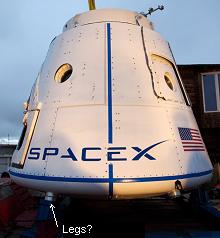
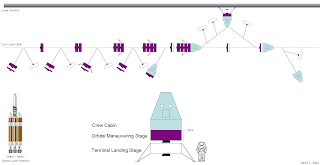
It's no secret that the SpaceX Dragon capsule has a very impressive heat shield believed to be capable of direct lunar return. Official statements from SpaceX that they intend to add deployable landing gear and leverage the thrusters in order to land on land in the future prompts an obvious suggestion: if it can land on Earth, could it land on the Moon too? The Dragon capsule has thus far been launched on the Falcon 9 booster, and although that booster is able to put 2473kg into lunar transfer orbit, after using the Draco thusters on the Dragon to enter low lunar orbit the total mass would be under 1876kg.. this seems a bit light for a crewed configuration, especially when you consider that only 1422kg of it could be returned to Earth. And that's just lunar orbit. We need a bigger rocket, and the official SpaceX plan right now is called the Falcon 9 Heavy. One should not be confused by the name, the F9H is not "heavy lift" in the sense often used by space ad...

Revolutionary Thinking in Nuclear Rockets

A few months ago I started talking to Jim Dewar about his latest book, which I reviewed in August . My suggestion to him was that he needs to write a better introduction that assumes the technical knowledge of rocketry but not the nuclear industry. He took on the task and recruited a number of people to serve as reviewers, myself included. So far, it hasn't been published anywhere, but he's given me a copy and invited me to publish it here. To avoid confusion, I've put it on my website: A Technical and Economic Introduction to Nuclear Rockets It's long but divided into sections, and I think Dewar has done a great job, so check it out. Jim tells me he would like to hear feedback.

Affordable Deep Space Exploration

Image
For too long the aspirations of NASA have not matched the budget allocated. Building the International Space Station has been a decade long effort, now finally reaching completion, and until just recently the plan was to splash it into the ocean before moving on to "the next thing". For a while, that was a return of humans to the Moon, but the recognition that the necessary budget would not be forthcoming has pushed that goal so far into the future that it doesn't even make much sense to talk about it anymore. Today, the focus is on making a new heavy lift vehicle, finishing a big heavy capsule to go on it, and considering the possible missions that could be done with that hardware should it ever be finished. At the same time, technology development and commercialization of ISS resupply promise to free up some existing budget dollars to pay for the lunar landers and prepare for the next next thing : Mars. This has prompted many to ask: what if we didn't need h...

Mining The Moon: Closing The Business Case

Image
I recently read Platinum Moon by Bill White, in just 4 days, it's just that much of a page-turner. Clark Lindsey has written an extensive review , which is mostly positive but has this little dig at the end: A kilogram of pure platinum today sells for something like $53,000/kg. On the Moon even rich PGM ore would have have to be extensively refined to get anywhere close to that purity. A kilogram of raw ore would be worth a tiny fraction of that. Until there are fully reusable vehicles flying frequently enough to LEO to bring costs there down to the low hundreds of dollars per kg, it's difficult to see how space mining can even begin to be viable. My first reaction is to suggest that obviously high purity enrichment of platinum should be done on the Moon, and only "pure platinum" returned to the Earth - but I should first point out that Platinum Moon made the realistic argument that lunar platinum would be worth a lot more than market value in the form of com...