Posts

Showing posts with the label rockets

Making Fusion Rockets Relevant
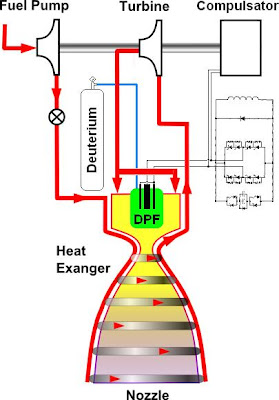
Image
If you read the literature on fusion rockets you probably have a pretty firm idea in mind of what they're good for and when they'll be relevant - in "the future". No good fusion rocket paper is complete without a superconducting magnet here, and a magnetic nozzle there - in fact, these widgets are a primary ingredient of any fusion propulsion design and the more infeasible or untested they are, the better. This seems obvious: fusion rockets are the future because we don't have fusion yet.. right? Actually, no. Producing nuclear fusion isn't all that hard. Amateurs regularly cobble together desktop fusion devices like the Farnsworth Fusor and other contraptions. The significant hard problem of fusion is getting more energy out of the device than you put into it. The current government backed effort to achieve this is the ITER project who are building a tokamak style device, but many other schemes are also being tried, with significantly less fundin...

Revolutionary Thinking in Nuclear Rockets

A few months ago I started talking to Jim Dewar about his latest book, which I reviewed in August . My suggestion to him was that he needs to write a better introduction that assumes the technical knowledge of rocketry but not the nuclear industry. He took on the task and recruited a number of people to serve as reviewers, myself included. So far, it hasn't been published anywhere, but he's given me a copy and invited me to publish it here. To avoid confusion, I've put it on my website: A Technical and Economic Introduction to Nuclear Rockets It's long but divided into sections, and I think Dewar has done a great job, so check it out. Jim tells me he would like to hear feedback.

Nuclear Rockets In The Atmosphere?

Image
In James Dewar's latest book he proposes the development of a new solid core highly enriched uranium rocket engine based on the B-4 core developed in the Rover/NERVA program, but unlike that program he recommends starting small, testing in a dedicated exhaust processing facility and building successive generations of engine to prove safety and gain operational experience. The first engine to be put into operation would have 40,000lbf (800MW), an ISP of 1,000s and weigh 6,000lb. It would have a maximum burn time of 15 minutes. The gross mass for the stage would be 91,000lb with 45,000lb of LH2 fuel, and a 3,000lb cocoon to recover the engine, to deliver a 17,000lb payload to LEO*. The stage would be dropped from 50,000ft by a cargo plane (such as the C-5A), and solid rocket boosters would carry it to 100,000ft before the solid core engine engages. The deorbited engine in its cocoon would be recovered from a splashdown for processing, as the U-235 would only be ~1% spent in the...

Scaled Composites' Dirty Little Secret

The public is incredibly easy to fool. Way back in 2004, Mike Melvill made history by flying Burt Rutan's beautiful creation SpaceShipOne across the unofficial border to space, twice, and later that year Brian Binnie did it again, winning the Ansari X-Prize and raising the hopes of all that private access to space had finally arrived. But how did they do it? There is no question that Burt Rutan is a natural genius at aircraft design. His true innovation on SpaceShipOne was the shuttlecock styled effortless reentry system, and in particular, the ease of replacing these two large booms after a few flights to mitigate wear. SpaceShipOne/Two is a glider, and just like the Space Shuttle the wings are "only" used on the way down. There are wings used on the way up, of course, they are on WhiteKnightOne/Two, but once separated from the carrier aircraft the only lift is generated from the rocket. As smart as Burt Rutan is, he's not a rocket guy. For SpaceShipOne he...

Sadly, SpaceX Schedule Slips Seem So Systematic

Once again, SpaceX's launch schedule has slipped, this time to no earlier than May 8, 2010 .  The previous date was April 12, but it seems they were never going to hit that date.  Of course, this doesn't mean the date hasn't been widely circulated.  The upcoming "space summit", at which President Obama is reportedly going to rally the troops to get behind commercial crew, was planned for 3 days after the launch.  For those out there who would assign some intricate public relations oriented reasoning to SpaceX's latest schedule slip, I'd like to remind them that slippages are nothing new for SpaceX.  The simple fact is, SpaceX has no idea what they're doing when it comes to PR.  If they did, they would have *made it clear* that they were not going to take advantage of the April 12 launch date long before now.  They would issue press releases about what the public is interested in, not about contracts they've signed for missions that are contingent o...