Posts

Showing posts with the label space policy

Dreaming About NASA Mismanagement

Image
There's so many things packed up in this clip. For a start, the House isn't trying to cut the James Web Space Telescope (JWST) because "we don't have the money" or to save money or for any budgetary reason what-so-ever. The House is trying to cut JWST because the Government Accountability Office reported that NASA, and the contractor, have been mismanaging this program. They reported this three different times and required reports on what NASA was going to do about it - NASA didn't provide those reports. The House even said that the reason they were looking to cut JWST was to send a message that ignoring oversight will not be tolerated. Does that mean the JWST isn't important? No.. no-one is saying that. Everyone agrees that JWST is important and that it will give results of significant scientific discoveries should it ever be completed and launched.. but when will that be? Within a two week period - after the House suggested cutting the budget ...
We've Already Got Propellant Depots

The solution to so many space logistics problems is: use a bigger rocket. Propellant depots allow you to add another solution: use more rockets. Now, for some reason, many people who are advocates of propellant depots object to just using existing space storable propellants because that would mean you'd need to launch more mass than if you used cryogenic propellants. Well, so what? More launches - that's a good thing! We don't need technology development to make propellant depots work. They already work.. we already have one in orbit! Suppose you want to send 100 tons to Mars transfer orbit. You need either 236 tons of storable propellant or 144 tons of cryogenic propellant (and that's being overly generous to cryogenics). Instead of 5 Falcon Heavy launches you now only need 3. So what? How much is that worth? So, ya know, NASA has selected companies to study storing cryogenic propellants in space .. and that's great. Technology development, in general, is...

Fooling Yourself

I was asked to comment on this article . I think Greg’s replies have done a better job than I ever could have in proving the futility of such comments. According to him, the world consists of the established and successful NASA and the young and inexperienced "New Space Boys" and no-one else. Inexplicably the Boeing corporation exists in both camps. The "whisper campaign" against Constellation, which no sensible person would deny existed, is absurdly attributed to "New Space Boys" in an effort to rewrite history – it was clearly NASA civil servants, contractors and other malcontents under the DIRECT banner who led that effort, advocating a Shuttle-derived launch vehicle over Griffin's Ares launch family. If the civil war inside NASA is to be divided into two camps at all, those are the battle lines which have been firmly established. But like all bipolar characterizations, this is also too simplistic. The enormity of Greg's worldview is jus...

The Role Of The Goverment

Recently I've been pondering the purpose of government spending on human spaceflight. My own politics typically preempt me from such thoughts as I honestly do believe that taxes should not be collected to fund non-essential services. However, I pride myself on being able to set aside my own ideology and think like others, in the hope of learning more about their motivations and possibly even understanding their actions. With that disclaimer out of the way, what is the legitimate role of government in human spaceflight? In general, the government should not compete with private industry. For example, if there is domestic production of cars, it is wrong for the government to set up their own car shops. Whatever goal the government is trying to achieve by doing such can almost certainly be better served through regulation or incentives. It's wrong because of the effect it would have on the industry. With the power of the treasury behind it, the government can sell cheape...

Page 113

I'm currently reading "Choice Not Fate" by James A. Vedda, Ph.D. It's a dry volume of 201 pages that rambles from historic interpretation to beltway praise for inane space policy and regularly promises the reader discussion on side points in later chapters that never come. On page 113 the author finally gets around to saying what I believe the entire book is actually about. In the future, NASA must be prepared to make judgments that will be interpreted as endorsements of particular companies or technical paths serving space markets, such as who receives government assistance and who doesn't. This places NASA in the position of making industrial policy decisions on who gets to develop space infrastructure and resources. Jesus, really? Up until this point I took the author's constant negative references to partisanship as a distaste to politics and assumed he had no particular leaning, way to yank the veil back dude. Now I have to consider whether not I ...

Some Retrospective Space Policy

It's been a while since I said anything about space policy. This is primarily because the whole ball of wax can be summarized as, well, a big fat mess. As many of you are likely aware, I was an avid viewer of the Augustine committee when it was on, all 37+ hours of it , and still think they did a fantastic job with what they had to work with. However, in retrospect, I think Norm Augustine hit the nail on the head when he started talking about "blue plate" options vs the alternatives that stuck within the existing NASA budget. I bet if they had to do it all over again they would have changed the balance to include more of the affordable options and less of the blue plate options. Perhaps they could have worked out the completion dates and total prices of the various components of Constellation program under the "restricted" budget (aka, the "real" budget) including the options of splashing the ISS in 2015 and without. As Augustine himself said ...

Early vs Late Human Missions To Deep Space

Image
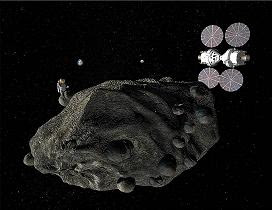
Anyone who has enjoyed my recreational attempts at designing a human mission to a near-Earth asteroid should check out the newly released mission to an asteroid by a team at Lockheed Martin*. The report ends with these important words: The Plymouth Rock study shows that the first visits to asteroids can be easier and earlier than we have previously thought. The United States does not need to wait for more advanced technologies or develop expensive dedicated deep space vehicles. We can explore the asteroids within a decade, using spacecraft already being developed and tested. This is a reasonable statement which I agree with. As far back as Apollo the question of "are we ready?" has been asked, and despite the success of Apollo it is still being asked. I have tried to make the argument that a Dragon capsule would be sufficient for a bare-bones mission to an asteroid, assuming some modifications to life support systems, dual use of propellant and supplies as radiation s...

Misrepresenting The Gap

Ever get that feeling you're shouting into the void? Rand Simberg, someone who's opinion on space I truly value, has written an article on The Gap, and taken the well trod path of how bad it is to be reliant on the damn Ruskies . With the coming retirement of the Space Shuttle, the most immediate issue in human spaceflight is how to get U.S. crews to the International Space Station. When the decision was made in 2004 to retire the shuttle, the plan was to have a small "gap" starting this year, during which the Russians would provide this service, as they did for the two-and-a-half-year period after Columbia was lost. But if lawmakers in the House have their way, we could be buying rides from Russia to the space station for the foreseeable future. Argh. Rand, you know better, so I'm just going to have to assume you're playing down to the saps who read AOL News (and I imagine they are saps, cause who reads that?). As you know, the Soyuz has been used...

My Reason For Human Lunar Return

Why go back to the Moon? I've asked that question a lot , and I've gotten a variety of answers. There's a lot of nice resources on the Moon and the energy requirements to lift them from the Moon is a lot less than required to lift them from the Earth. There's water, which can be used for propellant, and there's metals, both in the lunar regolith and in more significant deposits from asteroid impacts.. but I disagree that we need humans to retrieve those resources. The Apollo program only scratched the surface (literally) on lunar science. There's a whole lot of mysteries that lunar geologists don't have good answers for: nonmare domes, rilles, potentially active volcanic vents, the entire far side, and permanently shadowed craters.. but I again disagree that we need humans to do that science, and if NASA was at all serious about it they would have sent at least one rover to the Moon ever . I have advocated the viewpoint that what should motivate...

"Access To Space"

Andre Bormanis has an article over at The Space Review which includes this nugget: The US frequently partners with other countries and international organizations on space missions, primarily in the field of robotic exploration. Partnering in the development of manned systems has been resisted because of a belief, held deeply by many in government and among the public, that the US needs to have independent human access to space to maintain its status as a world power. If the Russians and Chinese can send people into orbit, so the reasoning goes, the US must as well, or risk being perceived as a declining power on the world stage. Oh, is that what "access to space" means? Well, as someone who is outside the US, I feel I can safely say: no-one cares . Yes, "soft power" exists, but no-one knows the names of astronauts anymore - they're just government employees who go up to an incomprehensible space station to pretend they're doing Important Work that ...

CCDev Is Dead

Image
Ok, I don't usually write these sorts of things, but I think this is so incredibly terrible news that I feel the need to vent. The NASA Authorization Act of 2010 kills the commercial crew development program, while simultaneously killing any chance of funding SpaceX's COTS-D option. It contains these lies: Sec. 241. Affirmation of Policy Reaffirms the policy of making use of United States commercially provided International Space Station crew transport and crew rescue services; limiting the use of the government system to non-ISS missions once commercial crew transport and crew rescue services meeting safety requirements become operational; and facilitating the transfer of NASA-developed technologies to United States commercial orbital human space transportation companies. All politicians lie, it's what they do, but it would be good if they could at least be consistent in the same document.  What follows in Sec 242 is a long list of restrictions to make it completel...

What Is The Gap?

I don't even know anymore. Buzz Aldrin has written another article , this time over at the Huffington Post. A number of my former colleagues, and other critics, have expressed concerns about the plan, and in particular, they express grave reservations about 'the Gap' -- the end of the Space Shuttle Program, and the inability for the US to provide human access to space -- save for limited flight opportunities and capabilities with our Russian partners, pending the maturing of the commercial space transportation capabilities, or other future systems to meet these needs. So it's about "human access to space". Ok, to do what? Why do you want human access to space? What's the point of it? Unless you address that question you can't seriously talk about what kind of access to space you need. Will suborbital access do? No? Ok, how about one orbit? No? Ok, how about 2 days? No? How about 2 weeks, the endurance of the shuttle? No? Oh, permane...

A Likely Scenario

I was recently asked, "if a killer asteroid was approaching Earth, how much would they actually tell us?" This is my response. They'd tell you numbers which you wouldn't understand. Then the pundits would turn those numbers into something they can scare you with, probably overblowing the threat while they do so, and Concerned Citizens would go to their Congressmen demanding answers. NASA would provide those answers.. in a completely unintelligible way, and someone would interpret those answers as dismissing the threat. Then there'd be a big argument over whether it's a threat or isn't it. Eventually one of the egg heads with a wife will get a lecture about talking like a normal person once in a while and a press statement would be released saying exactly how likely and excessive the threat is (after it went through a few committees to ensure it was easy enough to understand, and defend). By this time the media will be completely bored with the story ...

The Future Mines Of Humanity

Image
Dr Phil Harris is a Moon First space advocate and a published and acclaimed author. In his book Space Enterprise: Living and Working Offworld in the 21st Century , he goes into exquisite detail of the challenges and the bounties of industrializing the lunar surface. In early January of this year Harris authored a special White House strategy paper [redistributed with permission] which recommended a pushing forward on the Vision For Space Exploration, or at least the Moon focused vision that came out of it. He makes it very clear that the reason to go back to the Moon is to get resources and reduce the national debt. Now is the time to enlighten our nation's citizens of the vast resources to be tapped on the Moon. We could not only mine the lunar surface for valuable minerals and gems, but we could use its water and regolith to support lunar industrialization and settlement! Those last two words are the only mention of settlement in the entire paper - so this is an economi...

Desperately Seeking: Moon First Advocate

Image
As it seems Paul Spudis isn't going to respond I am left without a sparring partner. Anyone who wants to pick up the gloves and make the case for returning to the Moon, come at it. The ground rules are simple: you must make an argument as to why we should return to the Moon first . It would also be good if you could explain how NASA can do it within a time frame that can be sold politically and within the current budget profile, but I'll settle for a why that makes sense. Note that if you just preach the dogma of someone else, you're unlikely to be able to defend it, so, please, only apply if you've got the stones.

Walt Cunningham Advocates New NASA Goals

On the 4th of July former astronaut Walt Cunningham appeared on the Talking Space podcast to discuss NASA's future and other topics. Cunningham fundamentally disagrees with everything NASA is doing under the new administration. He thinks the shuttles should not be retired (although he acknowledges that the new administration inherited that situation) and should be evolved into a new vehicle. He accuses the White House administration of just wanting to cut the budget of human spaceflight altogether and alludes to activities which support this theory. Back in March he sent a similar statement to a public mailing list I'm (still unfortunately) on: "Lest there be any mistake, I believe Obama's removal of NASA from operation of the agency's own human space program is a major mistake. It was not an effort to improve our space program; it was purely to cut expenditures on something in which Obama has no belief. It was the second worst decision in NASA's histo...

The Gap Myth

Clara Moskowitz has published an article that tries to dispel a half dozen myths about the new space policy. Rand Simberg published an article back in May which tried to do the same. Whenever I read these articles I tend to see more myth usage than busting. As I've tried to articulate before, there's a lot of misunderstanding of the so-called "Gap" which neither of these articles bust. No discussion of Shuttle retirement makes sense if you don't mention two important things: The Soyuz has always been the vehicle used to rotate crews to the ISS as it has to act as a lifeboat - something the Shuttle can't do with it's 14 day on-orbit endurance. Ares I/Orion was supposed to be ready when the expedition crew size went from 2 to 6. It was clear it wasn't going to be, so NASA bought more seats on Soyuz which upped the required production of Soyuz, which increased the average price per seat. It should be clear, the myth here is that The Gap has mu...

Russian Failure

Sen John Glenn (ret) recently made a very well written, very in-depth statement about space policy. Compared to what other retired astronauts have been saying or suggesting, Glenn sounds outright prescient. I would like to address just one part of Glenn's statement. Russian Failure: And what happens if there is a failure of the usually reliable Soyuz? Just a couple of years ago, they had two reentry mishaps that took them over normal G limits and some 400 miles from their intended landing point. A grounded Soyuz would leave us with no access to the ISS. I presume the crew on board would have to come down by the so-called "lifeboat" Soyuz currently docked at the ISS. With no access, could the station even be abandoned, eventually to reenter the atmosphere in uncontrolled pieces, landing wherever? I find this very poor thought out and, compared to the rest of the statement, that is strange. As Glenn says earlier "The Shuttle first flew in late 1981 with its gre...