Posts

Showing posts with the label nasa

A Little Ray Of Sunshine

Well it seems someone managed to sneak into the commercial crew office at NASA and smack them with a clue stick. Today they announced that there will be a third round of Space Act Agreements to maximize the $406M awarded for the program in FY2012. That's the way NASA sees it anyway. What this actually means is that the partners which are selected - and we're told they desire to select more than one - will be free to pursue their own goals without the burdensome oversight of the growing commercial crew office. It means that companies like SpaceX can design their Dragon capsule to service both NASA's needs and the needs of other companies like the recently announced Statolaunch without asking Mother May I? I can't wait to see the milestones.

The Case Against SpaceX

As an advocate of commercial spaceflight I can understand why many find it difficult to write objectively about SpaceX - which is arguably the poster child of this nascent industry. As a result, the majority of negative commentary about our darling comes from a horrible "journalist" like Andy Pasztor at The Wall Street Journal or a traditional aerospace mouth-piece like Loren Thompson at Forbes. An occasional coherent comment on a blog or space forum may be accepted by the space community as containing a nugget of truth, but these are easily filed in the don't-think-too-hard-about basket and forgotten. I've taken to thinking about the criticism I have heard, and after some long and rather arduous discussion with these critics I've processed it through what I hope are reasonable and constructive filtering. Here's the finished package. The Circuitous Route To Reuse Since SpaceX first announced the Falcon 9 they have claimed it is designed to be reusable, bu...

Why Commercial Crew Is Doomed

Image
NASA's Commercial Crew Development program, or "CCDev", has been a resounding success - and that's why they're not doing it anymore. Inspired by the earlier Commercial Orbital Transportation Services program, or "COTS", and funded by the American Recovery and Reinvestment Act of 2009 stimulus to the tune of $50M, CCDev came out swinging in 2010 with five US companies producing impressive results on what was essentially bonus pay to NASA. As such, it was no surprise when a further $270M was provided for the second round, or "CCDev2". This round is now coming to a close, with continuing achievement from US companies with minimal oversight from NASA. Also, a number of "unfunded" CCDev agreements have been made which receive only use of NASA facilities and expertise - they too have been successful. With all this success, it might seem strange that NASA is dropping the CCDev program - but they are. They intend to move on to a "p...

This Is Why Space Settlement Is Important

Image
It's the end of civilization.. or so some would have us believe. If they don't get their wish, they intend to take it.. by force. Humanity going into space isn't about leaving them behind, but wouldn't it be nice? With my most humble apologies to Jeff Greason. As a follow up I posted this over at kuro5hin .

Cancelled Crew Transportation Systems

Image

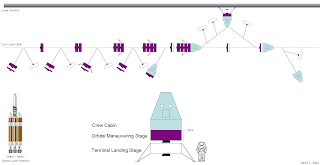
EML1 Buildup

Today's space launch market is used to place satellites - commercial, scientific and military - into orbit, with the majority going to the geostationary orbit. In all such cases, the launch vehicle does not perform the final maneuver to circularize the orbit. The satellite is dropped off and circularizes its own orbit using on-board propellant. This is a significant delta-v change of about 1.6 km/s, and the remaining fuel is used to maintain the orbit, usually for 25 years or more. Launch to Geostationary Transfer Orbit, circularize using on-board propellant. This is the standard model for how satellites are deployed into space. It is a mature process which has served us well for decades. However, when planning an exploration architecture, it has always been treated as irrelevant. Here is a list of some current (and one near future) launch vehicles, their listed throw mass to GTO and the calculated mass that can be placed into the first Earth-Moon Lagrange point using a 3...

Dreaming About NASA Mismanagement

Image
There's so many things packed up in this clip. For a start, the House isn't trying to cut the James Web Space Telescope (JWST) because "we don't have the money" or to save money or for any budgetary reason what-so-ever. The House is trying to cut JWST because the Government Accountability Office reported that NASA, and the contractor, have been mismanaging this program. They reported this three different times and required reports on what NASA was going to do about it - NASA didn't provide those reports. The House even said that the reason they were looking to cut JWST was to send a message that ignoring oversight will not be tolerated. Does that mean the JWST isn't important? No.. no-one is saying that. Everyone agrees that JWST is important and that it will give results of significant scientific discoveries should it ever be completed and launched.. but when will that be? Within a two week period - after the House suggested cutting the budget ...

NASA Is Going To Explore Deep Space

Image
Did you hear? The MPCV is crossing the country. You can go take your children to see the *cough* future of human spaceflight. Thanks to Rand Simberg for all the help with this video.

We Need Technology Development

Image
It seems pretty obvious that we don't currently have the technology to become a spacefaring civilization. Certainly there is stuff in space we could be doing using existing technology, and with great expense, but to really begin the human utilization and colonization of space we need a large variety of technological innovations. Jon Goff gave a great list of short term technologies that need to be developed before we can really consider society to be spacefaring. This should be the start of the story.

How COTS-D Was Killed

Lest we forget, under Mike Griffin NASA awarded to SpaceX an option in their Commercial Orbital Transportation Services contract to develop a crew transport capability. The Space Act Agreement looked like this: Milestone Payment Project Management Plan Review and Crew Demo 1 System Requirements Review $27,420,000 Financing D1 $10,000,000 Crew Demo 1 System Preliminary Design Review $22,420,000 Crew Demo 2 System Requirements Review $25,420,000 Crew Demo 1 Critical Design Review $20,420,000 Crew Demo 2 System Preliminary Design Review $20,420,000 Crew Demo 1 Demonstration Readiness Review $20,420,000 Crew Demo 3 System Requirements Review $25,420,000 Financing 2D $10,000,000 Crew Demo 2 Critical Design Review $18,420,000 Crew Demo 3 System Preliminary Design Review $20,420,000 Crew Demo 1 Mission $15,420,000 Crew Demo 2 Demonstration Readiness Review $18,420,000 Crew Demo 3 Critical Design Review $18,420,000 Crew Demo 2 Mission $8,420,000 Crew Demo 3 Demonstration ...

Two Game Changing Technologies

Image
The Gravity Loading Countermeasure Skinsuit (yes, that's Richard Garriott) and Mini-Magnetosphere Radiation Shielding are two technologies which, if successful, will change the way you think about space exploration and eventually even colonization. They address the two fundamental stumbling blocks of long term missions in space: the negative health affects of zero-g and radiation exposure. Zero-G Skinsuits exert a force on the wearer's body which duplicates the loading on the skeleton that gravity usually provides. The expectation is that Skinsuits will reduce or eliminate the deleterious bone loss that astronauts currently experience in zero-g. So far, the prototypes have only been tested on parabolic flights, although they are similar to the Russian penguin suits which were used by cosmonauts on MIR (unfortunately with little to no reported results - as is typical of Russian space medicine). Should Skinsuits turn out to be effective at eliminating bone loss, and pos...

How The Politicians Think

If you have one of these, turn it off now It's almost funny whenever a member of Congress opens their mouth and says something about NASA. Thankfully I don't pull my hair out or I'd be bald by now, it's just that funny. Here's a quick list of things I have to remember to make sense of US space policy. "Heavy Lift" means super heavy lift . Whenever a politician says "heavy lift", or just about anyone talking about space policy, they mean a vehicle that can lift more than 50 tons to LEO. Actually, they almost always mean a Saturn class vehicle.. and in many cases they actually just mean the Saturn V. When someone who actually works in the space industry says "heavy lift" they mean heavy lift - a vehicle that can lift more than 20 tons to LEO but less than 50 tons. And they almost always are talking about actual vehicles that you can place an order for right now. The workforce is precious , and capable and vital, except for when ...

My 2010 Review

I started this year thinking the Augustine committee had nailed the Moon shut. Considering that I was a proponent of Constellation before the Augustine committee, that's pretty significant. If I go back to that time and see what I was saying to people, most of it was explaining the flexible path as an alternative to sitting on the ground waiting for a booster and a capsule and a lander to be developed by NASA. I end this year thinking that the Moon isn't nailed shut. SpaceX has demonstrated that making a capsule and booster need not be expensive. Armadillo Aerospace and the other contractor's work on Project M (now Project Morpheus) demonstrated to me that going to the Moon need not be expensive. Tim Pickens and the Rocket City Space Pioneers have successfully restored my faith that the Google Lunar X-Prize will be won. Paul Spudis has actually become a robotic exploration advocate! In a few years time it won't be absurd to suggest that a commercial effort could ...

Apollo 8 Solo

Image
In 1927 Charles Lindbergh flew non-stop from Long Island to Paris. He was catapulted to instant fame by doing so and won the Orteig Prize . He didn't have a co-pilot. He didn't have an army of engineers monitoring his plane or a flight surgeon monitoring his heart rate, it was just him and his trusty single-engine monoplane, the Spirit of St. Louis . His achievement is heralded today as kick-starting the commercial aviation industry and opening up the skies to the everyman. But what of space? Could a modern Lindbergh fly an impossible journey and change the way we look at spaceflight forever? I think it can be done, and for cheaper than you might imagine. In 1968 the first humans left the vicinity of Earth, flew 6 days and nearly a million miles to the Moon and back. Their mission not only was the first, it also proved the feasibility of the missions to follow. Apollo 8 would have been much easier to achieve had they only wanted to swing-by the Moon, and still a sig...

Affordable Deep Space Exploration

Image
For too long the aspirations of NASA have not matched the budget allocated. Building the International Space Station has been a decade long effort, now finally reaching completion, and until just recently the plan was to splash it into the ocean before moving on to "the next thing". For a while, that was a return of humans to the Moon, but the recognition that the necessary budget would not be forthcoming has pushed that goal so far into the future that it doesn't even make much sense to talk about it anymore. Today, the focus is on making a new heavy lift vehicle, finishing a big heavy capsule to go on it, and considering the possible missions that could be done with that hardware should it ever be finished. At the same time, technology development and commercialization of ISS resupply promise to free up some existing budget dollars to pay for the lunar landers and prepare for the next next thing : Mars. This has prompted many to ask: what if we didn't need h...

Some Retrospective Space Policy

It's been a while since I said anything about space policy. This is primarily because the whole ball of wax can be summarized as, well, a big fat mess. As many of you are likely aware, I was an avid viewer of the Augustine committee when it was on, all 37+ hours of it , and still think they did a fantastic job with what they had to work with. However, in retrospect, I think Norm Augustine hit the nail on the head when he started talking about "blue plate" options vs the alternatives that stuck within the existing NASA budget. I bet if they had to do it all over again they would have changed the balance to include more of the affordable options and less of the blue plate options. Perhaps they could have worked out the completion dates and total prices of the various components of Constellation program under the "restricted" budget (aka, the "real" budget) including the options of splashing the ISS in 2015 and without. As Augustine himself said ...

Engineering An Asteroid Close Approach

Image
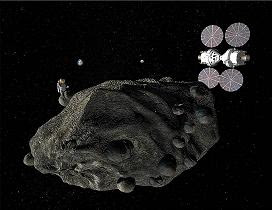
I've been posting lately about the threat large asteroids pose to Earth, human missions to smaller asteroids, and the opportunities that will exist in the next few decades to do so. Up until this point, my analysis has been mostly for my own education and amusement, but I'd like to make a suggestion now which I haven't seen published in the literature or seriously discussed in either NASA working groups or even in the space advocacy community. I'd like to suggest that we need not wait for an appropriate asteroid to come within range of Earth and plan human missions around just those opportunities - we can engineer a perfect close approach. Next year, at the start of June, the asteroid 2009 BD will pass within the orbit of the Moon . Even though it is not a rare occurrence, few opportunities such as this have been identified, and realistically, no-one is going to be ready to send a human mission to an asteroid for years to come. It seems a shame to let this clos...

Rusty Schweickart Explains The Asteroid Threat

I don't think he's given a better lecture than this.

Rock Envy

Image
With the exception of Hayabusa, all asteroid missions to-date have been to targets bigger than 1 km in "spherical radius". Date Encounter Asteroid Radius (km) Spacecraft 1991 Flyby 951 Gaspra 6.1 Galileo 1993 Flyby 243 Ida 15.7 Galileo 1999 Flyby 9969 Braille ~1 Deep Space 1 2000 Flyby 2685 Masursky ~8 Cassini 2001 Landing 433 Eros 8.42 NEAR Shoemaker 2002 Flyby 5535 Annefrank 2.4 Stardust 2005 Sample Return 25143 Itokawa 0.165 Hayabusa 2006 Flyby 132524 APL ~1.1 New Horizons 2008 Flyby 2867 Šteins ~2.8 Rosetta 2010 Flyby 21 Lutetia 95.8 Rosetta This has led a number of people to express dismay that all the asteroids which have been identified for human exploration missions have significantly smaller estimated sizes. Date Asteroid Radius (m) 2016 2008 HU4 ~5 2017 1991 VG ~45 2019 2008 EA9 ~6 2020 2007 UN12 ~4 2025 1999 AO10 ~35 2026 2008 JL24 ~2.5 2028 2006 RH120 ~2.5 2029 2000 SG344 ~22.5 Notice that the scale has changed from km to m. Of course...

Early vs Late Human Missions To Deep Space

Image
Anyone who has enjoyed my recreational attempts at designing a human mission to a near-Earth asteroid should check out the newly released mission to an asteroid by a team at Lockheed Martin*. The report ends with these important words: The Plymouth Rock study shows that the first visits to asteroids can be easier and earlier than we have previously thought. The United States does not need to wait for more advanced technologies or develop expensive dedicated deep space vehicles. We can explore the asteroids within a decade, using spacecraft already being developed and tested. This is a reasonable statement which I agree with. As far back as Apollo the question of "are we ready?" has been asked, and despite the success of Apollo it is still being asked. I have tried to make the argument that a Dragon capsule would be sufficient for a bare-bones mission to an asteroid, assuming some modifications to life support systems, dual use of propellant and supplies as radiation s...