Posts

Showing posts with the label spaceflight

EML1 Buildup

Today's space launch market is used to place satellites - commercial, scientific and military - into orbit, with the majority going to the geostationary orbit. In all such cases, the launch vehicle does not perform the final maneuver to circularize the orbit. The satellite is dropped off and circularizes its own orbit using on-board propellant. This is a significant delta-v change of about 1.6 km/s, and the remaining fuel is used to maintain the orbit, usually for 25 years or more. Launch to Geostationary Transfer Orbit, circularize using on-board propellant. This is the standard model for how satellites are deployed into space. It is a mature process which has served us well for decades. However, when planning an exploration architecture, it has always been treated as irrelevant. Here is a list of some current (and one near future) launch vehicles, their listed throw mass to GTO and the calculated mass that can be placed into the first Earth-Moon Lagrange point using a 3...
Early vs Late Human Missions To Deep Space

Image
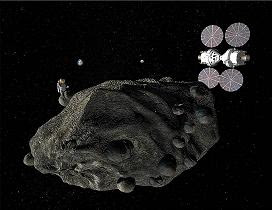
Anyone who has enjoyed my recreational attempts at designing a human mission to a near-Earth asteroid should check out the newly released mission to an asteroid by a team at Lockheed Martin*. The report ends with these important words: The Plymouth Rock study shows that the first visits to asteroids can be easier and earlier than we have previously thought. The United States does not need to wait for more advanced technologies or develop expensive dedicated deep space vehicles. We can explore the asteroids within a decade, using spacecraft already being developed and tested. This is a reasonable statement which I agree with. As far back as Apollo the question of "are we ready?" has been asked, and despite the success of Apollo it is still being asked. I have tried to make the argument that a Dragon capsule would be sufficient for a bare-bones mission to an asteroid, assuming some modifications to life support systems, dual use of propellant and supplies as radiation s...

Let's Focus On The Gap

The gap is unfortunate, but its a product of the previous administration, not a choice of the current one. The retirement date for the shuttle? An overdue decision finally made in 2003. The continual redesign of Ares 1 and the Orion capsule? Thank you Mr Griffin. If the simple safe soon replacement vehicle for the shuttle had been funded back in 2003 when it was supposed to be, and not co-opted for Apollo On Foodstamps, then it would be flying by now.. on existing launch vehicles. Instead we got the Constellation train wreck. So what has this administration decided to do? Close the gap by engaging *multiple* commercial providers. So if one vehicle fails, or retires, NASA can keep flying on another. There will never be a gap again. Basically what they should have done back in 2003 but without the cost plus pork. In the mean time, NASA astronauts will continue flying to the ISS on the Soyuz.. as nearly every expedition crew member flies to the station now. Th...