Posts

Rebirth Of The Spaceship
Image
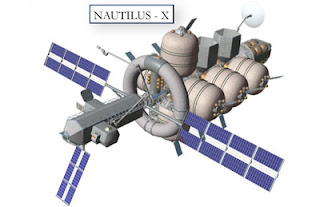
Over the last year the space advocate community has splintered into two major groups in answering the question "where should we go next?" Moon First or Mars First . This division was present in the Review of Human Spaceflight (aka Augustine) committee's final report in late 2009, with the surprising conclusion that there isn't the funds for either, suggesting a number of intermediate destinations first - including asteroids. However, as few people consider asteroids to be truly interesting destinations for the human utilization of space ( except me! ), the debate rages on. Many Moon First advocates are "Mars Next" advocates while most Mars First advocates are "Moon Again?" detractors. The former claim that Mars exploration will benefit from lunar exploration, particularly in experience and risk reduction, and perhaps the procurement of propellant. The latter claim that lunar exploration is just a distraction and want to avoid the risk of be...

You've gotta love him

Image
For anyone who wonders why I still love Bob Zubrin, watch this video: It's the passion. For anyone who needs a horrific demonstration of closed world thinking, combined with a little intellectual elitism, read on .

Please Stop Lying To Children

Image
Here in Australia we have a shameless tradition of claiming celebrities who are not quite Australian. The best example of this is probably Mel Gibson - back when anyone wanted to claim him - who wasn't actually born in Australia, he just lived here for a portion of his childhood. It is generally agreed that anyone who was born in New Zealand can never be considered an Australian ( just kidding kiwis, we love you ) but if they're famous they're automatically Australian. The common joke is that any celebrity who so much as flies over Australia will be offered citizenship. Something like the Australian celebrity phenomena happens when people start talking about NASA spinoffs, here's how it works: a speaker creates the implication that civil servant NASA scientists developed some new technology which was subsequently "spun off" to form a commercial product. The most common example of this is Velcro, but there are plenty of others. Whenever you dig into thes...

The Role Of The Goverment

Recently I've been pondering the purpose of government spending on human spaceflight. My own politics typically preempt me from such thoughts as I honestly do believe that taxes should not be collected to fund non-essential services. However, I pride myself on being able to set aside my own ideology and think like others, in the hope of learning more about their motivations and possibly even understanding their actions. With that disclaimer out of the way, what is the legitimate role of government in human spaceflight? In general, the government should not compete with private industry. For example, if there is domestic production of cars, it is wrong for the government to set up their own car shops. Whatever goal the government is trying to achieve by doing such can almost certainly be better served through regulation or incentives. It's wrong because of the effect it would have on the industry. With the power of the treasury behind it, the government can sell cheape...

Page 113

I'm currently reading "Choice Not Fate" by James A. Vedda, Ph.D. It's a dry volume of 201 pages that rambles from historic interpretation to beltway praise for inane space policy and regularly promises the reader discussion on side points in later chapters that never come. On page 113 the author finally gets around to saying what I believe the entire book is actually about. In the future, NASA must be prepared to make judgments that will be interpreted as endorsements of particular companies or technical paths serving space markets, such as who receives government assistance and who doesn't. This places NASA in the position of making industrial policy decisions on who gets to develop space infrastructure and resources. Jesus, really? Up until this point I took the author's constant negative references to partisanship as a distaste to politics and assumed he had no particular leaning, way to yank the veil back dude. Now I have to consider whether not I ...

They All Laughed At Christopher Columbus

Image
"I didn't expect to be ridiculed, for trying our best to change the world." - Gary Hudson My review of this book has been picked up by Moonandback , you can read it over there.

We Need Technology Development

Image
It seems pretty obvious that we don't currently have the technology to become a spacefaring civilization. Certainly there is stuff in space we could be doing using existing technology, and with great expense, but to really begin the human utilization and colonization of space we need a large variety of technological innovations. Jon Goff gave a great list of short term technologies that need to be developed before we can really consider society to be spacefaring. This should be the start of the story.

Charlie Bolden, Worst NASA Administrator Ever?

Image
Gah! He's telling you the answer and you still can't answer the question.

How COTS-D Was Killed

Lest we forget, under Mike Griffin NASA awarded to SpaceX an option in their Commercial Orbital Transportation Services contract to develop a crew transport capability. The Space Act Agreement looked like this: Milestone Payment Project Management Plan Review and Crew Demo 1 System Requirements Review $27,420,000 Financing D1 $10,000,000 Crew Demo 1 System Preliminary Design Review $22,420,000 Crew Demo 2 System Requirements Review $25,420,000 Crew Demo 1 Critical Design Review $20,420,000 Crew Demo 2 System Preliminary Design Review $20,420,000 Crew Demo 1 Demonstration Readiness Review $20,420,000 Crew Demo 3 System Requirements Review $25,420,000 Financing 2D $10,000,000 Crew Demo 2 Critical Design Review $18,420,000 Crew Demo 3 System Preliminary Design Review $20,420,000 Crew Demo 1 Mission $15,420,000 Crew Demo 2 Demonstration Readiness Review $18,420,000 Crew Demo 3 Critical Design Review $18,420,000 Crew Demo 2 Mission $8,420,000 Crew Demo 3 Demonstration ...

New Space Music Video

Image
An idea that has been bouncing around in my head for a few years.. Great to finally get it out.

Making Fusion Rockets Relevant

Image
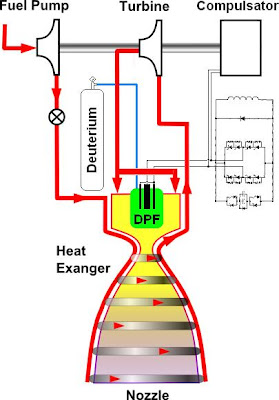
If you read the literature on fusion rockets you probably have a pretty firm idea in mind of what they're good for and when they'll be relevant - in "the future". No good fusion rocket paper is complete without a superconducting magnet here, and a magnetic nozzle there - in fact, these widgets are a primary ingredient of any fusion propulsion design and the more infeasible or untested they are, the better. This seems obvious: fusion rockets are the future because we don't have fusion yet.. right? Actually, no. Producing nuclear fusion isn't all that hard. Amateurs regularly cobble together desktop fusion devices like the Farnsworth Fusor and other contraptions. The significant hard problem of fusion is getting more energy out of the device than you put into it. The current government backed effort to achieve this is the ITER project who are building a tokamak style device, but many other schemes are also being tried, with significantly less fundin...

Space Colonization As The Savior Of Progress

The idea of Progress, as defined by J. B. Bury , proclaims that "civilization has moved, is moving, and will move in a desirable direction". Ever since the 1960s the belief in Progress has been waning and some would say that it has been completely lost to the current generation. Going beyond Bury's definition, Taylor E. Dark III provides three mutually reinforcing and interlocking premises : 1. NO LIMITS. There are no fundamental limits – nor should there be – on the collective human capacity to grow, no matter how growth is defined (which may be in terms of knowledge, wealth, power, population, or morality). Progress is endless (or at least indefinite for all practical purposes). 2. ALL GOOD THINGS GO TOGETHER. Advancements in science and technology, and the resulting mastery over nature, expand our knowledge, wealth, and power, and, in so doing, bring improvements in the moral, political, and spiritual character of the human race. The elements of progress ar...

The Easy Way To The Moon

Image
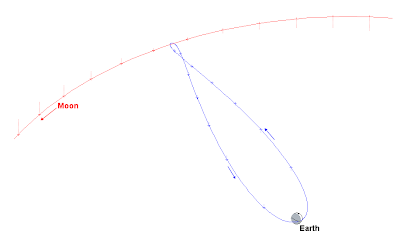
I recently described how to fly to the Moon solo using SpaceX hardware. Someone asked me why I worked out an Apollo 8 style flight and didn't just do a simple free return trajectory.. after all, it's a lot easier - and that's actually the reason - it's too dog gone easy. In order to make this interesting I decided to try to think of the easiest way to do a free return trajectory. Preferably, we'd like to use an unmodified spacecraft and launch vehicle and not have to develop any other hardware. For a start, let's forget this whole idea of an Earth Departure Stage - we'll just throw the Dragon spacecraft to lunar orbit. This sure is simple, but it only gives us 2585 kg to work with. This prompts the question, exactly what is the mass of an unladen Dragon.. yeah, yeah, I know - African or European? Looking at the Falcon 9 Users Guide we find that it can throw 9358 kg to 51.6º with an altitude of 400 km. SpaceX will happily tell you that the Drag...

Two Game Changing Technologies

Image
The Gravity Loading Countermeasure Skinsuit (yes, that's Richard Garriott) and Mini-Magnetosphere Radiation Shielding are two technologies which, if successful, will change the way you think about space exploration and eventually even colonization. They address the two fundamental stumbling blocks of long term missions in space: the negative health affects of zero-g and radiation exposure. Zero-G Skinsuits exert a force on the wearer's body which duplicates the loading on the skeleton that gravity usually provides. The expectation is that Skinsuits will reduce or eliminate the deleterious bone loss that astronauts currently experience in zero-g. So far, the prototypes have only been tested on parabolic flights, although they are similar to the Russian penguin suits which were used by cosmonauts on MIR (unfortunately with little to no reported results - as is typical of Russian space medicine). Should Skinsuits turn out to be effective at eliminating bone loss, and pos...

UFO Evidence (or the lack thereof)

Image
"I was on the beach, at the water's edge and looked to the west to see a beautiful, bright moon. Except it wasn't the moon! It was a bright light moving slowly east, towards me and surrounded by a swirling mist. The mist rotated clockwise around the bright, white light and followed it perfectly." Harry saw something strange in the sky, so he grabbed his video camera and put it up on youtube . It's a perfectly reasonable thing to do, and plenty of other people do the same. You could say it's a defining feature of the society we now live in. Most of us walk around with a camera in our pocket. Many of us whip out our camera phones to take a picture of anything interesting, funny, or even just to later post on Facebook to show that we're out having a fun time. As it turns out, this particular UFO was quickly identified as the second stage of the first Falcon 9 flight, spinning uncontrolled despite valiant efforts by the thrusters to correct the spin...

How The Politicians Think

If you have one of these, turn it off now It's almost funny whenever a member of Congress opens their mouth and says something about NASA. Thankfully I don't pull my hair out or I'd be bald by now, it's just that funny. Here's a quick list of things I have to remember to make sense of US space policy. "Heavy Lift" means super heavy lift . Whenever a politician says "heavy lift", or just about anyone talking about space policy, they mean a vehicle that can lift more than 50 tons to LEO. Actually, they almost always mean a Saturn class vehicle.. and in many cases they actually just mean the Saturn V. When someone who actually works in the space industry says "heavy lift" they mean heavy lift - a vehicle that can lift more than 20 tons to LEO but less than 50 tons. And they almost always are talking about actual vehicles that you can place an order for right now. The workforce is precious , and capable and vital, except for when ...

Mars Direct Without Super Heavy Lift

Image
For a decade or two now the proponents of Bob Zubrin's Mars Direct have been bemoaning the lack of super heavy lift (any vehicle that can lift more than 50 ton to LEO). While few advocates claim a heavy lift launch vehicle is the only component of the Mars Direct plan which is missing, most consider it a necessary prerequisite. Before I tell you why I think that's simply wrong, let's just make a quick list of all the other things we still need: decent life support, space suits for Mars, rovers that run on methane/LOX, the ISRU propellant production system, bigger entry/descent/landing systems than have ever been flown, portable field equipment for the science mission, artificial gravity generation, and the habitat itself. Oh yeah, and a space rated nuclear reactor. The beautiful innovation of the Mars Direct plan was the use of the Mars atmosphere to produce the return propellant so it doesn't need to be carried all the way from Earth. Without this simple idea t...

My 2010 Review

I started this year thinking the Augustine committee had nailed the Moon shut. Considering that I was a proponent of Constellation before the Augustine committee, that's pretty significant. If I go back to that time and see what I was saying to people, most of it was explaining the flexible path as an alternative to sitting on the ground waiting for a booster and a capsule and a lander to be developed by NASA. I end this year thinking that the Moon isn't nailed shut. SpaceX has demonstrated that making a capsule and booster need not be expensive. Armadillo Aerospace and the other contractor's work on Project M (now Project Morpheus) demonstrated to me that going to the Moon need not be expensive. Tim Pickens and the Rocket City Space Pioneers have successfully restored my faith that the Google Lunar X-Prize will be won. Paul Spudis has actually become a robotic exploration advocate! In a few years time it won't be absurd to suggest that a commercial effort could ...

Soonest Space Solar Power

Image
Space Solar Power has a bad rap, caused predominately by advocates who can't separate the exciting long term vision from the short term facts. In his recent paper , Al Globus has tried to rectify this by investigating what can be done with demonstrated launch vehicles, solar collectors and power beaming (and without on-orbit assembly, manned outposts, lunar materials, etc). His conclusion is that it appears space solar power is now ready for niche markets, such as forward military bases, where the price of power can be as much as $1/kWh. The low cost launch vehicle of choice is, of course, SpaceX's Falcon 9. High specific power solar collection is achieved using thin-film heliogyros as demonstrated by the Japanese Ikaros satellite. The power beaming technology is infrared laser with custom solar panel receivers, as demonstrated by LaserMotive in their win at the Space Elevator Games last year. A minor improvement in Globus' architecture is apparent. The mass of ...

Non-Rotating Artifical Gravity

Image
If you put a long boom on a satellite, it will align to the "local vertical". This was first demonstrated on the GOES 3 probe in 1978. It works because the forces of gravity and the "centrifugal force" balance at the center of mass. Today, long life space tethers are available, using existing materials they are light enough for long lengths to be launched on a cheap launch vehicle like SpaceX's Falcon 9. A length of 500 km, with a lifetime of 10 years, would have mass of just 1275 kg. The tether would stretch from the altitude of the International Space Station (~340 km) up past the altitude of the Hubble Space Telescope (~595 km), out to where the polar orbiting satellites do their job (~700 km+). Within equal masses on each end of the tether, a force of 0.1g would be experienced, with no rotation of the structure required. Of course, this only works while in orbit around a planetary body. Around the Sun, say for generating artificial gravity for a...